
Teaching the World’s First University-Level Elixir / Phoenix Course
From the very first lecture, students dove into a stack that even many professional developers haven’t touched: functional programming in Elixir and full-stack web development in Phoenix with TailwindCSS and LiveView. This wasn’t a “toy example” class either—by the end of the semester, students had built production-grade applications that could stand proudly in any developer portfolio.
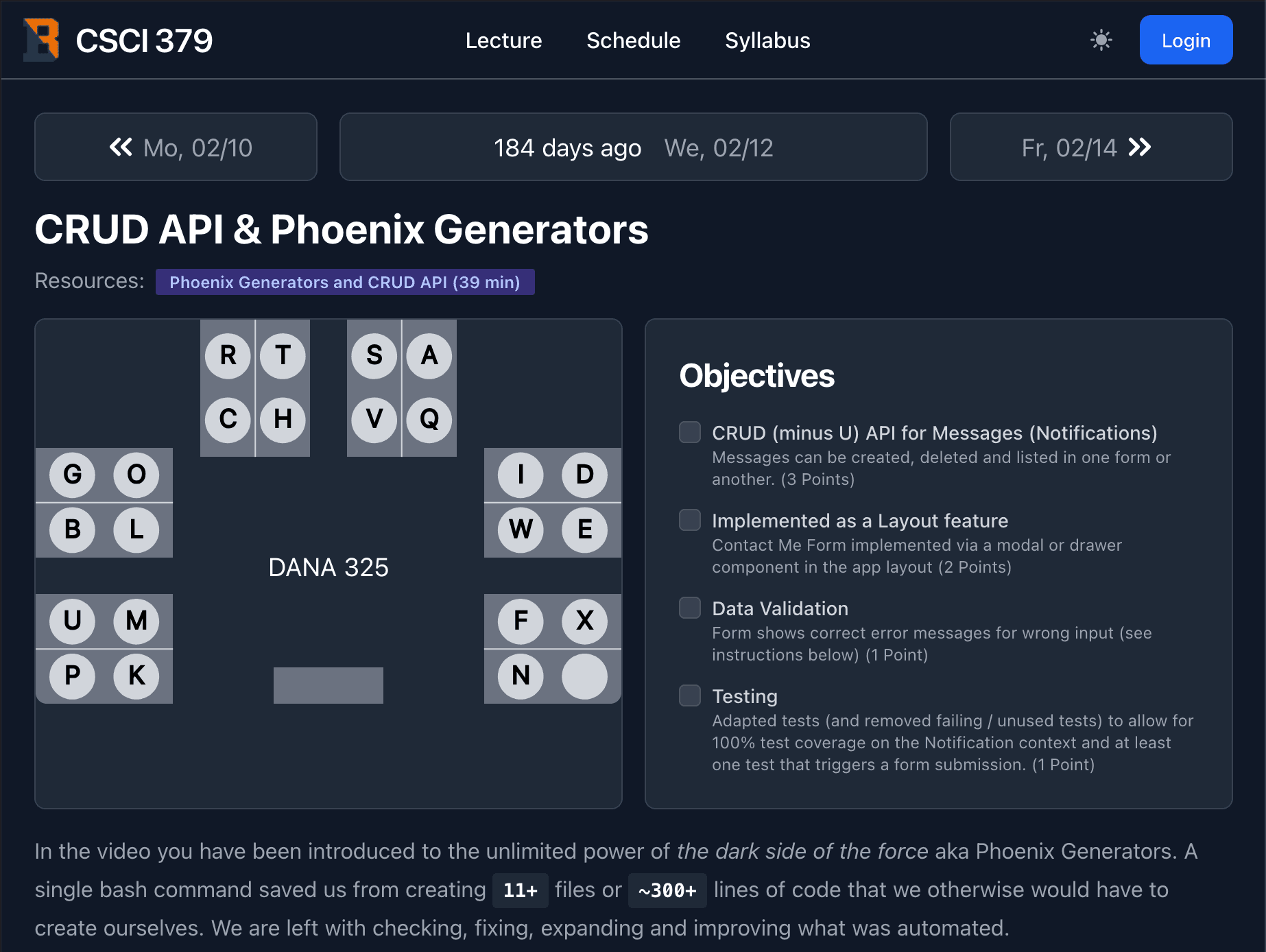
The Experience
The course was designed to simulate a professional development environment. Students learned to manage Git repositories, track issues, implement real-time features, validate user input, and deploy their projects to the cloud. We flipped the classroom — video lessons before lecture, in-class pair programming, and a final project that pulled together everything they had learned.
It was also a place where AI wasn’t a forbidden shortcut but a welcomed collaborator. Students integrated large language models into their work in ways I could never have predicted.
Learning Outcomes
By the end of the semester, students had mastered:
- Introduction to functional programming paradigms, including atoms, piping and pattern matching
- Elixir syntax and data types
- Error and exception handling and coverage testing in Elixir
- Introduction to web development with Phoenix framework
- Building RESTful APIs with Phoenix
- Implementing real-time communication in web applications
- Validating and saving user input through forms and PostgreSQL database
- Front-End UI Design and interactivity using TailwindCSS and Phoenix LiveView
- Front-End UI Design with mobile-first, accessibility features and User Experience (UX) in mind
Final Projects That Blew My Mind
Some of the projects at the end of the semester genuinely left me speechless. Here are just two standouts:
-
AI Dungeon Master for Dungeons & Dragons – An immersive, browser-based RPG experience with a GPT-powered dungeon master that reacted to player actions in real time.
-
Medical Monitoring Platform – A system capable of synchronizing live patient sensor data, automatically detecting irregularities, and adjusting treatment protocols on the fly.
These weren’t just “cool” projects—they were sophisticated, technically challenging, and incredibly polished.
Career Impact
Two of my students have already written to tell me they landed web development jobs, and both said the course was instrumental in helping them ace technical interviews. That’s exactly the outcome I was hoping for when I built this class: to give students not just knowledge, but the confidence and skill set to stand out in the job market.
Looking Ahead to Spring 2026
The course will be offered again in Spring 2026, and I couldn’t be more excited for what’s next:
-
Re-recorded and updated video content for a smoother learning experience.
-
Expanded Phoenix scopes for more powerful and maintainable code.
-
Modernized security practices, including a hands-on module on passkey implementation.
-
More AI integration – I’m exploring ways to use AI not just as a tool, but as a teaching assistant that can help students debug and optimize their code.
-
Streamlined deployment with a focus on building releases and CLI
If last semester was any indication, Spring 2026 will push the boundaries even further.
Teaching this course has been one of the most rewarding experiences of my career — watching students light up as they master challenging concepts, seeing them push their creativity to the limits, and knowing they’re leaving with skills that are directly marketable in today’s tech world.
Here’s to another semester of innovation, problem-solving, and a few more mind-blowing final projects.